Before you change anything, know what the machine is reading
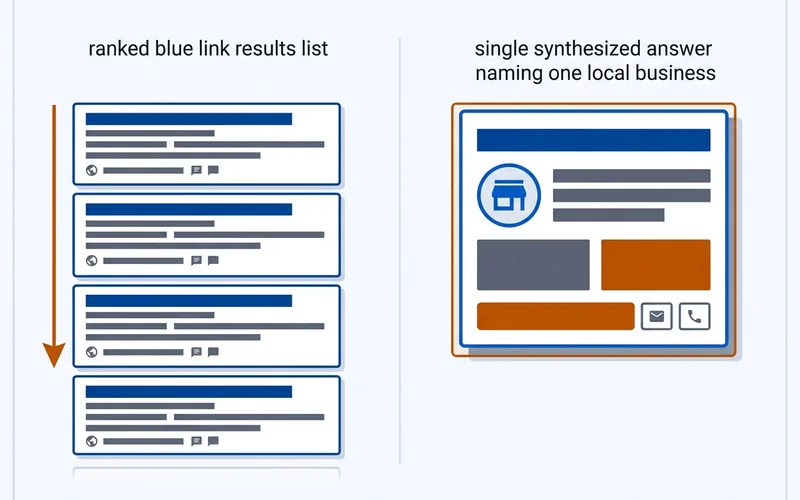
Ask ChatGPT who can fix a burst pipe in Boise tonight and it will not hand you ten blue links. It writes a short paragraph, names one or two plumbers, and lists the pages it leaned on. That paragraph is put together at the moment you ask, from documents the system went and fetched. It is not recalled from memory.
That one fact explains most of this course. A large language model does not hold a reliable record of your opening hours. It holds language. The specifics come from retrieval: the system finds documents that look relevant to the question, reads them, and writes an answer grounded in what it found. The industry calls this retrieval-augmented generation, or RAG. Grounding is the term for tying a generated sentence back to a source it retrieved.
So the question stops being "how do I rank" and becomes "what documents exist about my business, and do they agree with each other".
Meet Halvorsen Plumbing
Every lesson in this course uses the same worked example, so you can watch one business go through the whole process. Halvorsen Plumbing is made up. Any resemblance to a real plumber is accidental.
Britt Halvorsen runs it from one shop on West Main Street in Boise, Idaho. Four licensed plumbers, three vans, trading since 2014. The service area is Boise plus three suburbs: Meridian, Nampa and Eagle. Emergency callouts run 24 hours a day, with a promise of being on site within 90 minutes anywhere inside that area. Standard callout is $89, waived if you go ahead with the repair; after-hours callout is $189. The Google Business Profile shows 214 reviews at a 4.7 average.
When someone in Meridian types "emergency plumber near me open now" into an AI assistant, whether Halvorsen gets named depends on what the system can find and whether it all says the same thing. Keep that scene in mind through the four stages below.
The four stages, and where you sit in them
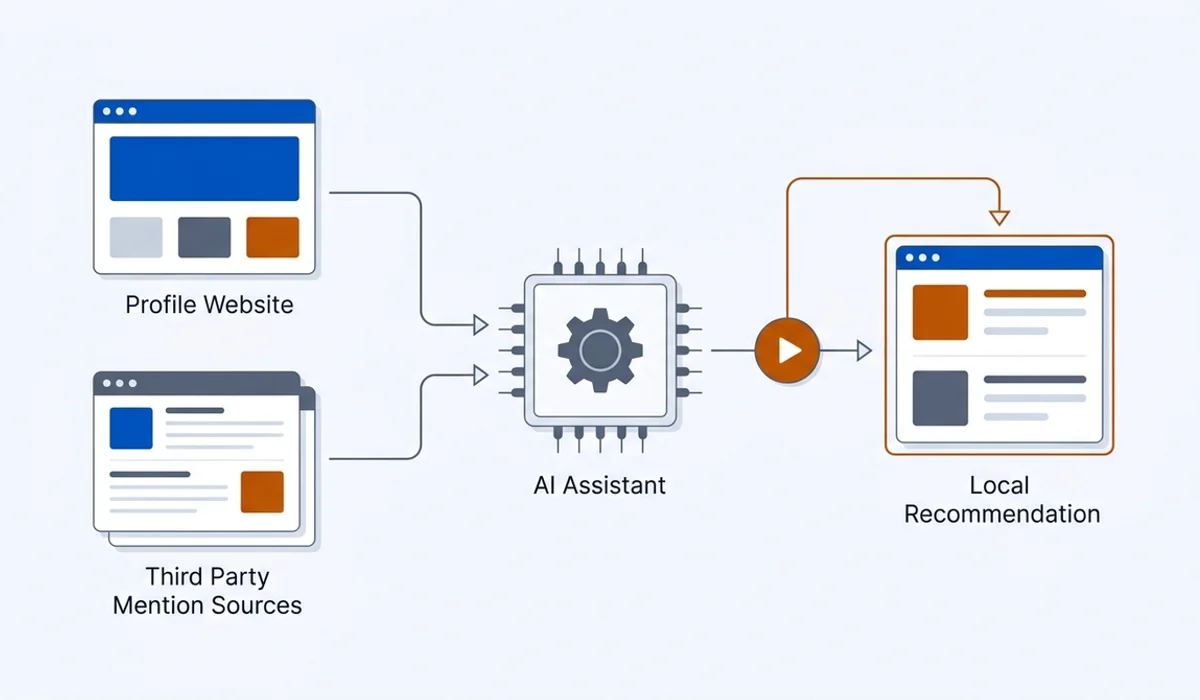
Every local recommendation goes through roughly the same sequence.
Query. The assistant takes the customer's phrasing, works out the intent, and often rewrites it into several narrower searches. Google describes this for AI Mode as query fan-out: the system issues multiple related searches across subtopics and data sources, then stitches the results together (Google, 5 March 2025, checked 16 September 2026). "Who can fix a burst pipe tonight in Meridian" may fan out into a search for 24-hour plumbers, one for Meridian coverage, and one for pricing.
Retrieval. The system gathers candidate documents. For a local question that usually means Google Business Profile data, pages from business websites, and third-party sources such as directories, review sites and local press. Retrieval is mostly semantic rather than keyword-exact, which is why a page written in customer language can be pulled without matching the exact words.
Grounding. The retrieved passages are attached to the prompt so the model writes from them rather than from memory. This is the stage that decides whether your facts or somebody else's end up in the sentence.
Answer. The model writes a short response and, in most interfaces, attaches citations: the numbered links or source cards under the paragraph.
You cannot edit stages one, two or four. You have a great deal of control over what is available to be retrieved at stage two and grounded at stage three, which is where this course spends its time.
Three sources, unequal weight
For a local business, retrieval almost always draws on three kinds of source.
Your Google Business Profile is the densest single record of your facts: name, address, phone, category, hours, services. Google says its own local results are based mainly on relevance, distance and prominence (Google Business Profile Help, checked 21 September 2026), and the profile is where two of those three are read from. Lesson 2 is entirely about it.
Your website is where nuance lives. A profile cannot explain that Halvorsen does gas lines but not septic, or that the 90-minute promise covers Eagle but not Kuna. Only your pages can say that, and only if they say it plainly. Lesson 3 covers the page shapes that get pulled.
Third-party mentions are everything else: directory listings, review sites, a chamber page, local news, a forum thread where somebody recommended you. What other sites say about you is treated as independent corroboration. Lesson 6 covers them.
| Source | What it is best at | Where it falls short |
|---|---|---|
| Google Business Profile | Core facts: name, address, phone, category, hours | Cannot express nuance or exclusions |
| Your website | Scope, exclusions, pricing logic, service detail | Only counts if the page states it plainly |
| Third-party mentions | Independent corroboration of your facts and reputation | You do not control when they are updated |
The common failure is not absence, it is contradiction. Halvorsen's profile says Saturday 8am to 2pm, the website footer says Saturday by appointment, and a directory listing from 2019 still shows the old shop on Fairview Avenue. Faced with conflicting sources, an engine hedges, picks the majority reading, or names the competitor whose facts are unanimous.
Being named is not the same as ranking
Classic SEO chases a position. AI search produces a different unit of value: your business appears inside the sentence, sometimes with a link and often without. BrightEdge measured ChatGPT mentioning brands about 3.2 times more often than it cites them with a link, 2.4 mentions against 0.74 citations per prompt (BrightEdge, checked 17 September 2026). A customer can learn Halvorsen's name, its 90-minute promise and its callout fee without visiting the site.
This matters for how you read your analytics. Ahrefs found that when an AI Overview appears, the page in position 1 gets a 58.0% lower average clickthrough rate across 300,000 keywords (Ahrefs, 4 February 2026, checked 17 September 2026). At the same time, Semrush measured AI referral traffic at under 0.15% of total visits across 50,000+ sites in 2025 (Semrush, 27 April 2026, checked 17 September 2026). Put those together and the honest picture is: AI answers are read a lot, they send few clicks, and a mention inside one can still be worth a phone call.
The vocabulary around this is messy. Some people call optimising for it Generative Engine Optimization, or GEO. Others say Answer Engine Optimization, or AEO. Wikipedia lists GEO, AEO, AIO, LLMO and AI SEO as overlapping terms with no consensus definition (checked 17 September 2026). The guide on whether GEO asks anything different of a local business untangles them, and the AEO versus GEO versus local SEO comparison settles which one a vendor is actually pitching you. The labels matter far less than the work.
One more thing worth knowing: Google states there are no additional requirements to appear in AI Overviews or AI Mode, no special files and no special schema (Google Search Central, page updated 10 December 2025, checked 17 September 2026). Anyone selling you a secret AI ranking factor is selling you the ordinary work with a new label.
The crawlers that make any of this possible
Retrieval needs a copy of your page, and that copy arrives through named crawlers that do different jobs. OpenAI documents GPTBot for training data, OAI-SearchBot for surfacing sites in ChatGPT search, and ChatGPT-User for fetching a page when a user's prompt needs it (OpenAI, checked 21 September 2026). Perplexity documents PerplexityBot for its search index and Perplexity-User for live fetches (Perplexity, checked 21 September 2026). Anthropic documents ClaudeBot, Claude-SearchBot and Claude-User with the same split (Anthropic, checked 21 September 2026).
The distinction matters when somebody suggests blocking them. Blocking the search-side crawlers removes you from the answers you are trying to appear in. The guide on which AI crawlers read your site lists the user agents, and Lesson 5 covers what to allow.
Where you can realistically intervene
Three places, in this order.
Make your facts unanimous. Every place a customer or an engine can read your name, address, phone number, category and hours should say the same thing. Unglamorous, and the highest-return work available to a small business.
Make your pages answerable. Write passages that stand on their own: a clear question, a direct answer, a specific fact. A sentence lifted out of your page should still make sense and still be true.
Make your data machine-readable. Structured data hands the engine your facts in a form it cannot misread. Lesson 4 covers LocalBusiness schema, including a block for Halvorsen you can adapt.
One rule follows from the grounding stage. The system is not judging prose. It is looking for claims it can restate without risk. A plain sentence with a price, a suburb and a response window is low risk. A polished paragraph that implies all three and states none cannot be checked against anything, so it is skipped. When you have to choose between making a page more persuasive and making it more specific, choose specific. Persuasion works on a reader who already has your name. Specificity is what gets your name into the answer.
If an assistant is naming a competitor instead of you, one of those three is almost always the reason. The diagnostic guide on why AI recommends a competitor walks the three checks in about thirty minutes.
Exercise
Run the 5-minute self-test on your own business before you read Lesson 2.
- Open a private browser window so you are logged out of everything.
- Write down the exact question a customer would ask, in their words. For Halvorsen it is "emergency plumber in Meridian open now". Do not include your business name.
- Ask it in three places: Google (look for the AI Overview or switch to AI Mode), ChatGPT and Perplexity.
- For each one, note who was named and which sources appear under the answer.
- Open every cited source that mentions you or a competitor. Compare name, address, phone and hours against your profile and your website.
Keep the sheet. Lesson 7 turns it into a monthly routine, and you will want the baseline.
Check your work
- You asked the question logged out, without your business name in it.
- You recorded who was named in each of the three engines, even if it was nobody.
- You listed the cited sources, not just the answer text.
- You found at least one place where your facts appear (or noted that you found none).
- You wrote down every mismatch between sources, including small ones like a suite number or "Ste" versus "Suite".
- You can say, in one sentence, why an answer is assembled rather than recalled.
Sources
- Google, "AI Mode in Search", 5 March 2025, describes query fan-out: https://blog.google/products-and-platforms/products/search/ai-mode-search/ (checked 16 September 2026)
- Google Search Central, "AI features and your website", page updated 10 December 2025: https://developers.google.com/search/docs/appearance/ai-features (checked 17 September 2026)
- Google Business Profile Help, "Tips to improve your local ranking on Google": https://support.google.com/business/answer/7091 (checked 21 September 2026)
- BrightEdge, ChatGPT brand mentions versus citations: https://www.brightedge.com/resources/weekly-ai-search-insights/chatgpt-brand-mentions-vs-citations-what-triggers-visibility (checked 17 September 2026)
- Ahrefs, Ryan Law, "AI Overviews reduce clicks" update, 4 February 2026: https://ahrefs.com/blog/ai-overviews-reduce-clicks-update (checked 17 September 2026)
- Semrush, Margarita Loktionova, traffic channel mix study, 27 April 2026: https://www.semrush.com/blog/traffic-channel-mix-study/ (checked 17 September 2026)
- Wikipedia, "Generative engine optimization": https://en.wikipedia.org/wiki/Generative_engine_optimization (checked 17 September 2026)
- OpenAI, crawler and user agent documentation: https://developers.openai.com/api/docs/bots (checked 21 September 2026)
- Perplexity, crawler documentation: https://docs.perplexity.ai/guides/bots (checked 21 September 2026)
- Anthropic, "Does Anthropic crawl data from the web": https://support.claude.com/en/articles/8896518-does-anthropic-crawl-data-from-the-web-and-how-can-site-owners-block-the-crawler (checked 21 September 2026)