Start with what cannot be measured
Measurement in AI search is immature, and most of the confident reporting you will be sold is inference dressed as data. Being clear about the gaps is the only way to build a routine you can trust.
You cannot get a reliable citation count. There is no published figure for how often an assistant named your business this month. You cannot track a citation rank, because there is no ranked list. You cannot fully reproduce results, because the same prompt run twice can return different sources. And you cannot see conversations, so most zero-click attribution is guesswork.
Two public numbers frame the scale. Semrush measured AI referral traffic at under 0.15% of total visits across 50,000+ sites in 2025, even after growing 66% in the year (Semrush, 27 April 2026, checked 17 September 2026). BrightEdge measured ChatGPT mentioning brands about 3.2 times more often than it links to them (BrightEdge, checked 17 September 2026). So most of the value of being named never shows up as a click, and the clicks that do arrive are a small number. That is why you measure mentions by looking, not by waiting for analytics.
What you can do is run a controlled, repeatable observation and watch it over time. That is less satisfying than a dashboard and considerably more honest.
The prompt set
This is the core method, and it takes about fifteen minutes.
Build the set once. Write five to ten questions a real customer would ask. For Halvorsen Plumbing, the fictional Boise plumber this course follows, the set is: "emergency plumber in Meridian open now", "how much does a water heater replacement cost in Boise", "plumber near Eagle Idaho that does gas lines", "who unblocks drains in Nampa", and six more in the same shape. Use their words, not your keyword list. Never include your business name, or you are only testing whether you exist.
Run it under fixed conditions. Logged out, same three engines each time (Google AI Mode or the AI Overview, ChatGPT, Perplexity), same wording. Keep a note of your location, because assistants infer it from your connection and that shapes local answers. If you use a VPN or a different city, record that, because comparability is the whole point.
Record what you see. For each prompt and each engine: were you named, who else was named, and which sources were cited. That last column is the most useful one, because it tells you which of your assets the engine can currently see.
The guide on testing whether ChatGPT recommends your business has the full method, including how to avoid the self-deception traps.
The weekly log
Keep one sheet. One row per prompt per engine per run. Halvorsen's looks like this after week one:
| Date | Prompt | Engine | Named? | Who was named | Sources cited |
|---|---|---|---|---|---|
| 2026-09-28 | emergency plumber in Meridian open now | ChatGPT | No | Two competitors | Yelp, one competitor site |
| 2026-09-28 | emergency plumber in Meridian open now | Perplexity | No | Three competitors | Yelp, a directory, Google Maps |
| 2026-09-28 | water heater replacement cost in Boise | ChatGPT | No | One competitor, a national chain | Competitor page, a cost guide |
| 2026-09-28 | water heater replacement cost in Boise | Perplexity | Yes | Halvorsen and two others | Halvorsen water heater page, Yelp |
Log weekly, decide monthly. Weekly rows are cheap and give you enough points to see a trend; monthly is when you read the sheet and choose one action. Reacting to a single week's row is how people make pointless changes.
Run an off-cycle check when something specific changes: you correct a major listing, you rewrite a page, you change your primary category, or a customer reports that an assistant told them something wrong. The guide on how often to re-check sets out the full rhythm.
The supporting signals
Three sources add context around the prompt set.
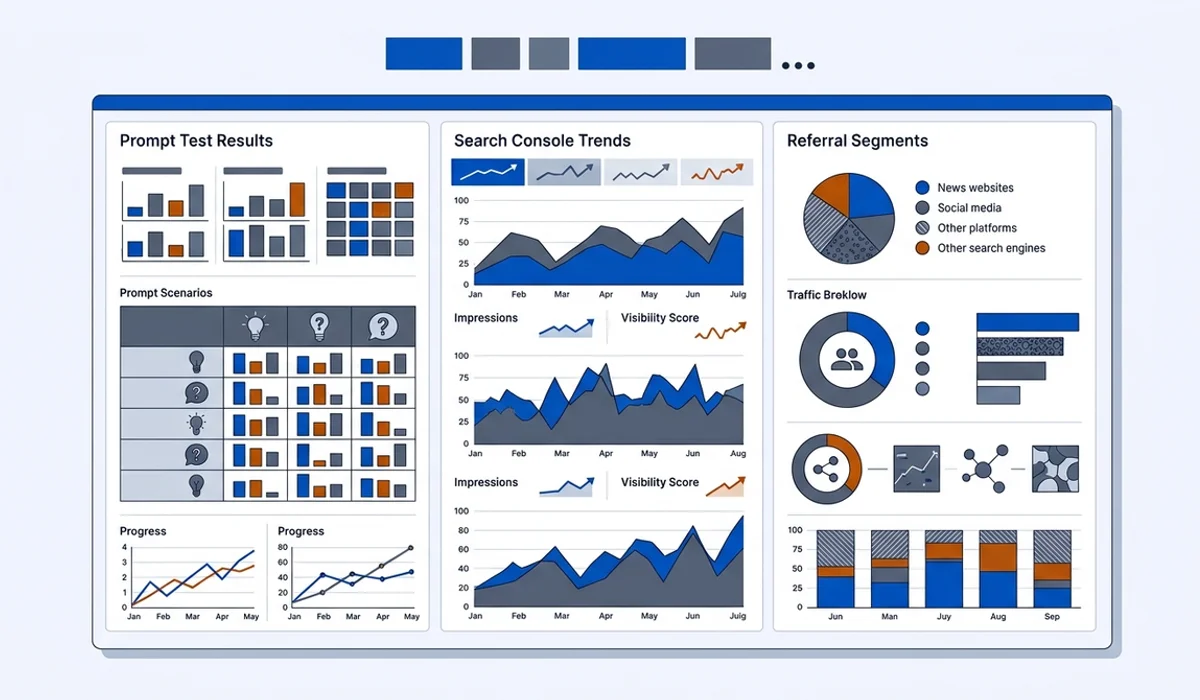
Google Search Console. Google states that AI Overview and AI Mode activity is included in the overall web search traffic in the Performance report, and does not offer a separate AI filter (Google Search Central, page updated 10 December 2025, checked 17 September 2026). So you are reading hints: impression growth on queries where AI surfaces appear, shifts in the queries you surface for, and the gap between impressions and clicks. A widening gap on informational queries is consistent with answers being read without a visit: Ahrefs measured a 58.0% lower clickthrough rate at position 1 when an AI Overview is present (Ahrefs, 4 February 2026, checked 17 September 2026). It is not proof of a citation and should not be reported as one.
Referral traffic. Some assistants send identifiable referral traffic (chatgpt.com, perplexity.ai and similar referrers). Segment those in your analytics and watch the trend rather than the absolute number, which will be small. A handful of sessions a month from an assistant is normal and still meaningful, because the visitor arrived already informed.
Server logs. From Lesson 5, confirming that the named crawlers arrive and receive 200 responses. If they stopped arriving, that is worth knowing before you spend a month wondering why nothing moved.
Share of voice, meaning how often you are named versus named competitors across your prompt set, is a reasonable derived metric as long as you present it as what it is: your own observation, from your own sample, on a given date. Free trackers exist that automate the prompt run; treat their output the same way, as a sample on a date, and check a few rows by hand each month.
What a realistic 90-day curve looks like
Owners expect a line that goes up. What a site actually produces over its first quarter is lumpier, and the shape below is what to expect from the plan in this course rather than a promise.
Weeks one to four usually show nothing in the prompt set. The profile is fixed, the pages are rewritten, and the engines are still citing the sources they cited before. Search Console impressions may tick up on branded queries first, because the profile and site now agree.
Weeks five to eight are where the first "Yes" rows tend to appear, and they appear on the narrowest prompts first: the ones that name a specific service and a specific suburb, where the rewritten page is the most direct answer available. Halvorsen's first named row was the water heater cost prompt, not the emergency one, because the water heater page states a price and the emergency page competes with every plumber in the valley.
Weeks nine to thirteen are inconsistent by nature. A prompt that named you in week ten may not in week eleven. Read the count across the month, not the row. If the monthly count of named rows is higher than the previous month's, the work is landing. If a new competitor keeps appearing, open the sources column and read what they published.
When the answer is wrong rather than absent
Sometimes the problem is not invisibility, it is misinformation: an old phone number, a closed location, a service you dropped. The fix almost always starts off-platform, because the engine is repeating a source. Correct the source, then use the platform feedback route, then wait, because re-crawling happens on their schedule not yours. The guide on what to do when AI search says something wrong covers the routes and realistic timelines.
Going deeper. A scored measurement loop across many sites, engines and prompts is where a spreadsheet stops and AI SEO Rainmakers picks up; it covers this with weekly tested playbooks at seo.stream.
Exercise
Run your baseline this week and set up the log.
- Write ten customer questions in customer phrasing, each naming a service or a suburb, none naming your business.
- Open a private window. Run all ten in Google (AI Overview or AI Mode), ChatGPT and Perplexity. Thirty rows.
- For each row record named or not, who was named, and the sources cited. Save the sheet with today's date.
- In Search Console, note total impressions and clicks for the last 28 days, and screenshot the top 20 queries.
- In your analytics, create a segment for referrals from assistant domains and note the last 28 days' sessions.
- Put a 15-minute weekly repeat in your calendar, and a 30-minute monthly review where you choose one action.
Check your work
- Your prompt set has five to ten questions, none of which contain your business name.
- Every row in the log has a date, an engine, a named-or-not value and a sources column.
- You ran it logged out and recorded the location you ran it from.
- Search Console and referral baselines are recorded with a date range.
- The weekly run and the monthly decision are both in the calendar.
- You have written down one action for this month, and only one.
Sources
- Google Search Central, "AI features and your website", page updated 10 December 2025, on Search Console reporting: https://developers.google.com/search/docs/appearance/ai-features (checked 17 September 2026)
- Semrush, Margarita Loktionova, traffic channel mix study, 27 April 2026: https://www.semrush.com/blog/traffic-channel-mix-study/ (checked 17 September 2026)
- BrightEdge, ChatGPT brand mentions versus citations: https://www.brightedge.com/resources/weekly-ai-search-insights/chatgpt-brand-mentions-vs-citations-what-triggers-visibility (checked 17 September 2026)
- Ahrefs, Ryan Law, "AI Overviews reduce clicks" update, 4 February 2026: https://ahrefs.com/blog/ai-overviews-reduce-clicks-update (checked 17 September 2026)
- SEO.Stream, public description of AI SEO Rainmakers: https://seo.stream/ (checked 17 September 2026)