
The short answer
Mostly no. Generative Engine Optimization, GEO, is the work of making a business understandable enough to an AI system that the system names it inside an answer; the fuller definition, along with the competing terms and their history, is on aiseocourse.wiki. For a local business it is not a new discipline. The work list underneath it is the one this course already teaches, with two shifts of emphasis described below.
Here is the situation the term describes. A customer asks an assistant who can replace a water heater in Meridian this week. The assistant writes a paragraph, names one or two plumbers and lists the sources it used. GEO is everything you do to make sure the business it names is yours. Not ranks it. Names it.
If you want the mechanics behind that answer, they are in how AI search picks local businesses, which covers the retrieval sequence this page assumes.
How it differs from classic SEO
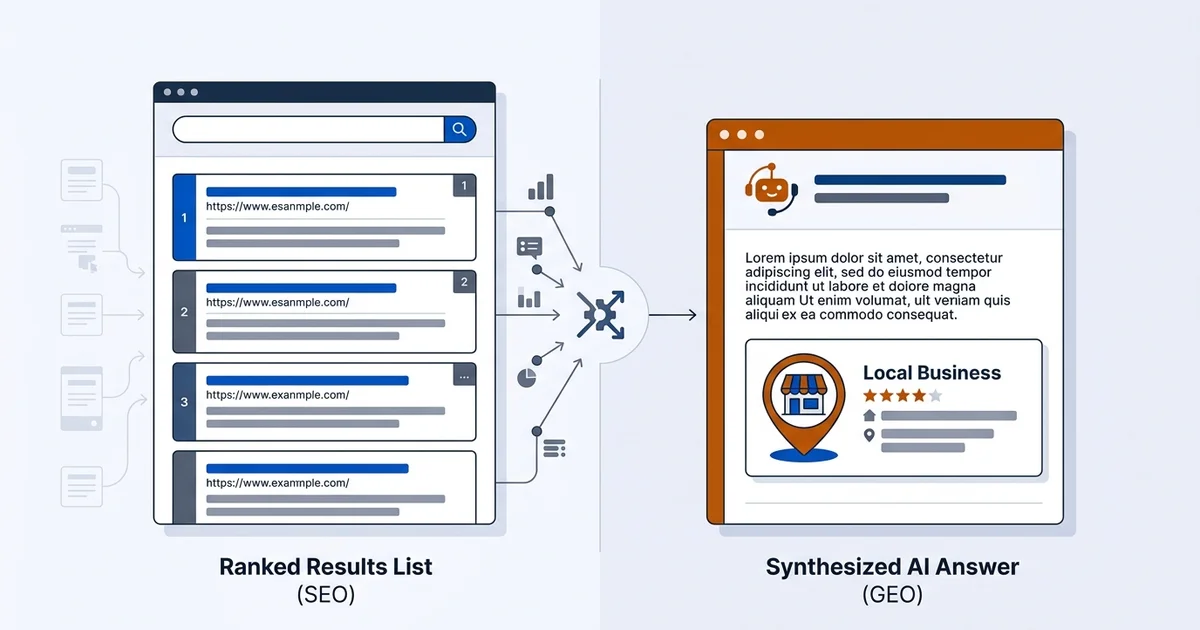
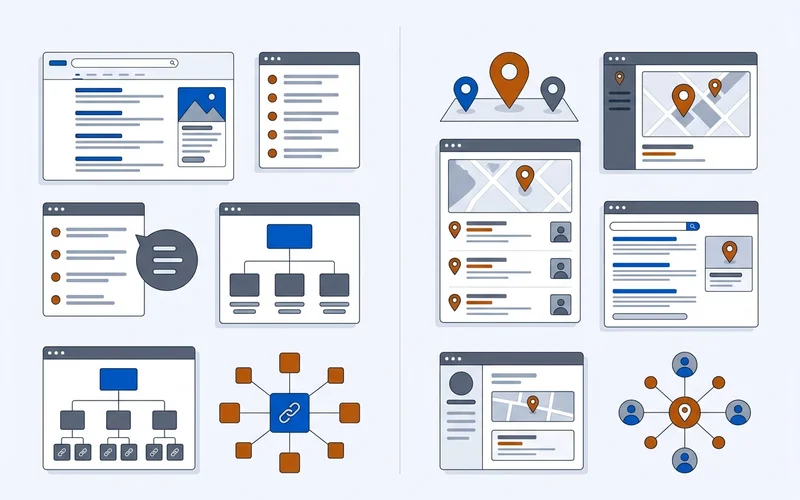
Classic SEO optimises for a position in a list. The unit of value is a link, and the measurement is a rank.
GEO optimises for inclusion in a synthesized answer. The unit of value is a sentence that names you, and there is no rank to measure. A customer may never visit your site at all, having learned your name, your speciality and your hours from the answer itself.
The practical differences follow from that:
- Passage over page. Retrieval pulls chunks of text, so a page that is good overall but has no self-contained paragraph gets skipped.
- Facts over adjectives. "Fast, reliable service" cannot be corroborated. "On site within four hours across three named suburbs" can.
- Consistency over cleverness. Contradictory hours across two listings cause hedged answers no amount of good copy will fix.
- Entity over keyword. The engine is trying to resolve which business you are before deciding whether to name you.
What has not changed: a crawlable site, clear structure, accurate business information and genuine third-party corroboration were always the foundation of local SEO. GEO leans on them harder.
What a local business actually changes
Four things, in this order.
Make your facts unanimous. Name, address or service area, phone, category and hours should read identically on your profile, your site and every directory that carries you. This is the single highest-return task available, and it is the one owners most often skip in favour of writing more content.
Write passages that survive extraction. Question as a heading, answer in the first sentence, then a checkable fact. If a paragraph lifted out of your page still makes sense to a stranger, it is a candidate for quoting.
State the awkward things. Publish a price range and name your service areas. Vagueness is not neutral here. It removes the specific detail an engine needs to state you as the answer.
Add structured data. LocalBusiness JSON-LD hands the engine your facts in a form it cannot misread. It matters most when your entity is ambiguous, such as a service-area business with no public address.
None of that requires a vendor, a subscription or a platform migration.
Why the term matters less than the work
You will see GEO, AEO, AI SEO and answer optimisation used interchangeably, sometimes in the same proposal, usually with confident distinctions that dissolve under questioning. The comparison of AEO, GEO and local SEO untangles the terminology properly.
A useful test when someone pitches you GEO services: ask what they would change in your first 30 days. If the answer names your business profile, specific pages and specific listings, they are describing real work. If the answer is about authority, visibility and broad optimisation, you are buying a label.
Where this sits in the course
Google states there are no additional requirements to appear in AI Overviews or AI Mode, and no special markup or files (Google Search Central, page updated 10 December 2025, checked 21 September 2026). Read that as confirmation that the ordinary work is the work. This course is a GEO course, even though it rarely uses the word. Lessons 2 through 6 are the four changes above, worked through properly, and Lesson 7 is how to tell whether they landed.
If you are starting from zero, read Lesson 1 for the mechanics, then work the 90-day checklist, which sequences the whole thing into three months of short sessions.
Which parts of this course map to which GEO activity
If you want to translate the label into a work plan, the mapping is direct.
| GEO activity | Where it is covered |
|---|---|
| Understanding retrieval and citation | Lesson 1 |
| Entity data and fact consistency | Lesson 2 |
| Passage-level content design | Lesson 3 |
| Structured data and entity resolution | Lesson 4 |
| Crawlability and crawler permissions | Lesson 5 |
| Off-site corroboration | Lesson 6 |
| Measurement and iteration | Lesson 7 |
Nothing in that table is exotic, which is the point. GEO is not a separate channel with its own budget line. It is the same local marketing fundamentals, aimed at a machine that writes sentences instead of a page that lists links.
Three objections worth answering
"This is just SEO with a new name." Largely true, and that is a reason to be reassured rather than cynical. Wikipedia lists GEO, AEO, AIO, LLMO and AI SEO as overlapping terms with no consensus definition, and a Forrester analyst quoted there argues advocates exaggerate the differences from SEO (checked 17 September 2026). The shift that is genuinely new is passage-level extraction and the disappearance of the click, and both change what you write rather than what discipline you hire.
"The engines will change, so why bother." They will, and the foundation will not. Accurate facts, clear answers and machine-readable data have survived every ranking change of the last fifteen years. The surface detail dates; the underlying requirement does not.
"My customers do not use ChatGPT." Some do, more will, and AI Overviews already sit above ordinary Google results for many local queries. You do not have to believe in a revolution to think your phone number should be correct everywhere.
Sources
- Wikipedia, "Generative engine optimization", definition, competing terms and the Forrester analyst view: https://en.wikipedia.org/wiki/Generative_engine_optimization (checked 17 September 2026)
- Google Search Central, "AI features and your website", page updated 10 December 2025: https://developers.google.com/search/docs/appearance/ai-features (checked 21 September 2026)
- Aggarwal et al., "GEO: Generative Engine Optimization", arXiv, submitted 16 November 2023: https://arxiv.org/abs/2311.09735 (checked 16 September 2026)
- aiseocourse.wiki, reference entry with the fuller definition and history: https://aiseocourse.wiki/ (checked 21 September 2026)